
The Agent That Learns From You
Hermes arrived in February and just overtook OpenClaw on OpenRouter. Here’s how it scores on the same framework, and when to choose which.

In April I wrote about OpenClaw and three questions worth asking about any AI agent: does it wait for you or watch for you, does it persist or disappear when you close the tab, does it remember or require you to re-explain? I called OpenClaw the leading open-source embodiment of the proactive, always-on, memory-first pattern and noted the gap between fascinating and ready for founders was closing, not closed.
Two things have happened since. The gap has continued closing. And a second strong contender has entered the same category.
What Hermes is (and what it isn’t)
Hermes Agent is an open-source autonomous agent framework from Nous Research, released in February 2026 under the MIT license. By mid-May it had accumulated 135K+ GitHub stars — one of the fastest-growing agent frameworks of 2026 by star count. On May 10, 2026, it overtook OpenClaw on OpenRouter’s global daily token rankings: 224 billion daily tokens to OpenClaw’s 186 billion.
Get the category right before reading on. Hermes is not a coding agent. It’s not a Claude Code competitor or an OpenHands alternative for software engineering tasks. It lives in the same category as OpenClaw: a persistent, general-purpose agent that runs on your machine, reaches you through your messaging channels, and handles recurring workflows across your working life. The tools built for pure coding work — Claude Code, OpenCode, Cline — occupy a different category entirely. Hermes doesn’t displace them.
Model-agnostic by design: Claude, GPT, Gemini, Ollama, any OpenAI-compatible endpoint. Nineteen-plus messaging channels: Slack, Discord, Telegram, Teams, WhatsApp, Signal, email, CLI. Forty-plus built-in tools: web search, browser automation, file operations, code execution. Runs wherever you run it — local, Docker, SSH, Vercel Sandbox, Modal.
Running the three questions
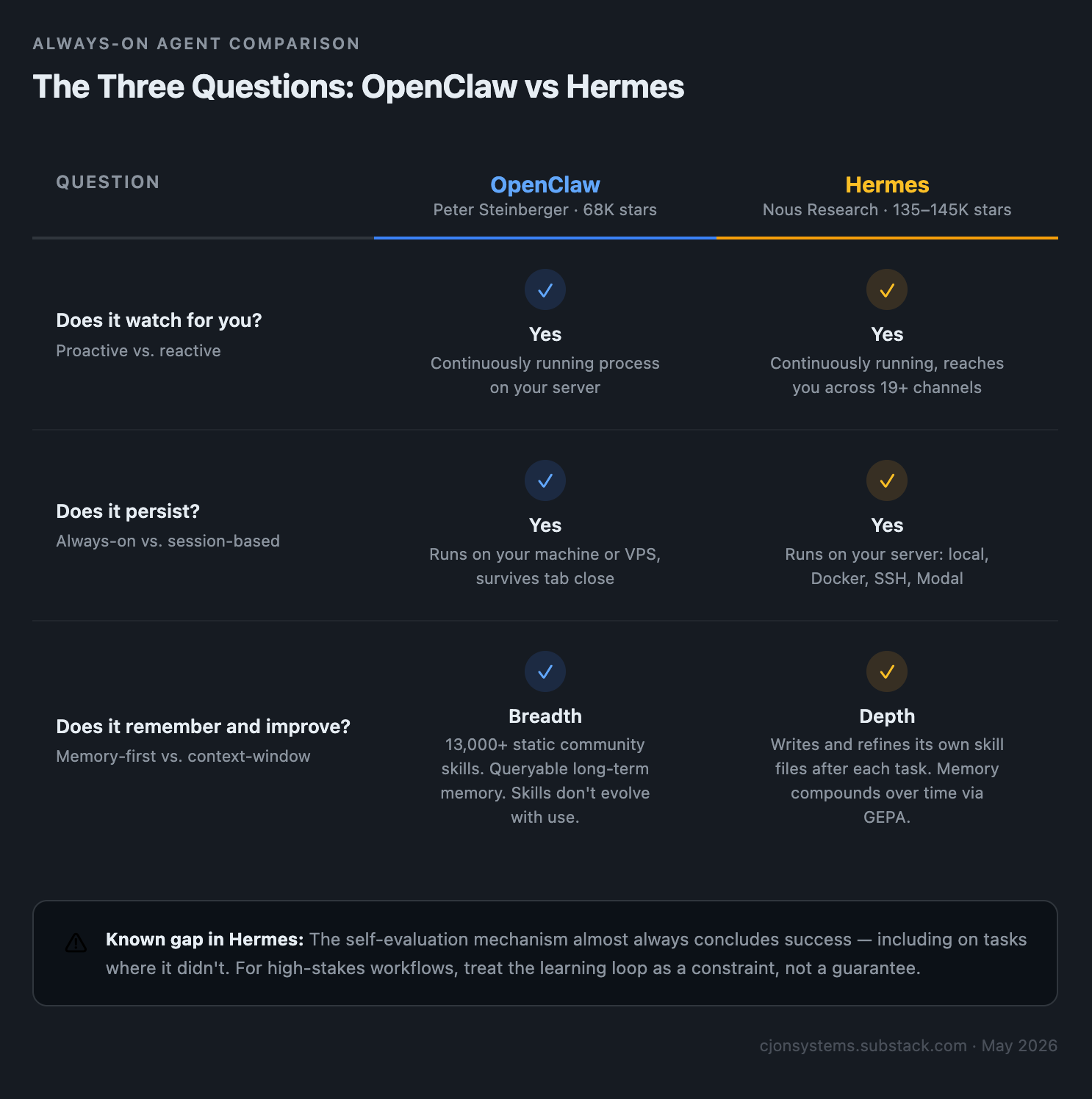
When I applied the April framework to OpenClaw, all three questions came back positive. Hermes answers the same three questions — but not identically.
Does it wait for you or watch for you? Hermes watches. It’s proactive by design, a continuously running process rather than a session you open and close. Same answer as OpenClaw.
Does it persist or disappear when you close the tab? It persists. Same answer as OpenClaw.
Does it remember or require you to re-explain? This is where the answers diverge.
OpenClaw has memory: structured, queryable, better than a context window. But its skills are static Markdown files that the community writes. You get 13,000-plus skills at install, and they don’t change based on your usage.
Hermes has memory that compounds. After completing a task, it extracts the successful pattern, writes a reusable skill file, and refines that file on each subsequent use. A mechanism called GEPA continues evolving those skills beyond their original version. Cross-session recall uses full-text search with LLM summarization, paired with a persistent user model that builds understanding of who you are and how you work over time.
The difference: OpenClaw gives you breadth. Hermes gives you depth that grows.
The learning loop in practice
This is the piece worth spending time on, because it’s genuinely novel in an open-source agent at this scale.
The loop: Hermes executes a task. It extracts what worked. It writes a skill file with instructions and examples. Every time it handles a similar task, it updates that file. The agent you use in week eight knows your research cadence, your communication patterns, your recurring workflows — not because you told it once, but because it observed and recorded.
For recurring workflows — the kind that define how a small team operates — this is a different kind of leverage than static tools offer. A tool that improves through use changes the economics of the relationship.
The honest gap: Hermes evaluates its own success, and it almost always concludes it succeeded, including on tasks where it didn’t. This is a documented design flaw in the self-evaluation mechanism. The learning loop is only as good as the feedback signal, and right now that signal is consistently optimistic in a way that doesn’t always match reality. For anything high-stakes, this is the thing to watch.
When to choose what
The always-on agent category now has two credible open-source options. The choice isn’t which is better — it depends on what you need.
Choose OpenClaw (built by Peter Steinberger, founder of PSPDFKit) if breadth is the priority. Twenty-four-plus messaging platforms, 13,000-plus community skills, a framework that has been running longer and has more rough edges filed down. The static skill library means you’re not waiting for the agent to learn your patterns — you’re deploying established ones from day one.
Choose Hermes if depth is the priority. You have recurring workflows you want the agent to improve at over time. You’re comfortable running a February 2026 release that is still actively developing, and you’re willing to treat the self-evaluation limitation as a constraint that shapes which tasks you assign.
Choose Claude Code or OpenCode for anything primarily involving writing, editing, and debugging code. Hermes is not optimized for that use case. Neither is OpenClaw. The always-on agent category and the coding agent category are solving different problems.
Choose OpenHands if you want a fully autonomous software engineer running unattended in a sandboxed Docker environment. Different category again — fully autonomous coding execution, not persistent personal assistant.
The risk right now is conflating these categories because they all use the word “agent.” The question is always: what are you automating, and what failure mode is acceptable if the agent gets it wrong?
Where this leaves the pattern
In April, the always-on, memory-first, proactive pattern had one strong open-source implementation and a set of proprietary signals pointing in the same direction: Claude Code’s background scheduling, Cowork’s persistent context, the direction the ecosystem was clearly heading.
Two months later: two strong open-source implementations, a competitive market between them, Jensen Huang’s public endorsement of the underlying pattern at GTC 2026, and Hermes overtaking the incumbent on the largest model routing platform by daily usage.
The gap between fascinating and ready for founders is closing faster than expected. The safe use cases remain the same: internal tooling, low-stakes recurring workflows, knowledge management, background research. High-stakes production tasks are still too early given where self-evaluation reliability sits.
But the window for founders to understand this pattern and find their first safe deployment is narrowing. The founders who get in deliberately — not recklessly, but early — will have built the muscle by the time the category matures.
The three questions still work. The number of tools that score high on all three is growing.
Using Hermes or OpenClaw already? Leave a comment with what you’re running it on. I read every one.
Questions? Leave a comment below or connect on LinkedIn.